BS 5839-1:2025 explained: fire alarm categories, testing and what changed
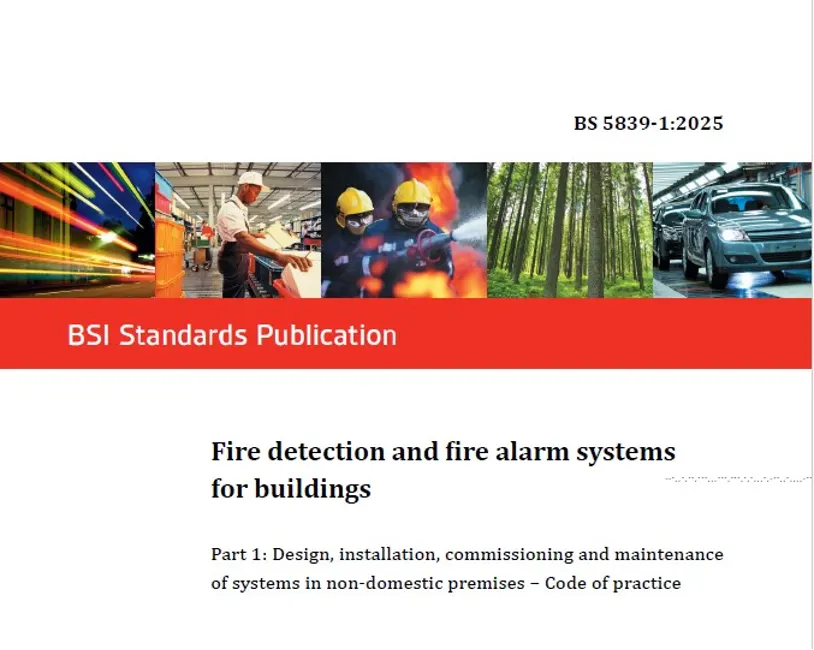
BS 5839-1 is the British Standard code of practice for fire detection and fire alarm systems in non-domestic buildings. It covers how a system should be designed, installed, commissioned and maintained. The 2025 edition replaced the 2017 edition, and it changes several things that building owners and managers need to know about.
This guide explains what the standard covers, the system categories, what changed in 2025, and how often your fire alarm should be tested and serviced.
Who does BS 5839-1 apply to?
Part 1 covers non-domestic premises: offices, shops, factories, warehouses, schools, hotels, care homes and the common areas of many residential buildings. Fire alarms in individual homes are covered by a separate part, BS 5839-6.
BS 5839-1 is not itself law. But the Regulatory Reform (Fire Safety) Order 2005 requires the responsible person to provide suitable fire detection and warning, and BS 5839-1 is the benchmark that fire and rescue services, insurers and building control use to judge whether a system is suitable. If your system falls short of it, you will need a good reason.
Fire alarm categories
Every system is designed to a category. The category should come from your fire risk assessment.
| Category | Purpose | Where detection goes |
|---|---|---|
| M | Life safety, manual only | Manual call points only, no automatic detection |
| L1 | Life safety | Automatic detection throughout the building |
| L2 | Life safety | Escape routes, plus rooms that open onto them and other high-risk rooms |
| L3 | Life safety | Escape routes and rooms that open onto them |
| L4 | Life safety | Escape routes only, such as corridors and stairways |
| L5 | Life safety | A specific area identified in the fire risk assessment |
| P1 | Property protection | Automatic detection throughout the building |
| P2 | Property protection | High-risk areas only |
Most commercial buildings need at least an L or M system, and many combine them, for example M/L3.
What changed in BS 5839-1:2025
The Fire Industry Association has published a detailed guide to the changes. The main ones for building owners are:
- Sleeping rooms are now high risk in L2 systems. Rooms where people sleep must be protected in an L2 system, and heat detectors are no longer acceptable there.
- L4 systems need detection at the top of flue-like structures, where smoke can travel up through a building.
- Fewer “variations” are allowed. Some shortcuts that used to be accepted as site-specific variations are no longer acceptable. For example, a residential care home without a link to an alarm receiving centre, or a multi-zone building with no zone plan, especially where people sleep.
- Every agreed variation must be recorded in the logbook, not just the major ones.
- Faster monitoring for remotely monitored systems. For Category L systems, a fire signal should reach the alarm receiving centre within 90 seconds, and a total failure of the link should show within 3 minutes.
- A new warning label is recommended on or beside the fire alarm panel when the system has an active connection to the fire and rescue service through a monitoring centre.
- New section on extensions and modifications, so changes to existing systems are handled more consistently.
- Servicing details tightened: the panel clock must be checked at every service, batteries should be labelled with their installation date, and redundant devices should be removed or clearly marked as out of use.
- Competence: the standard notes that engineers are likely to need continuing professional development to stay competent.
How often should a fire alarm be tested?
Every week, someone on site should operate a manual call point and check the alarm sounds and the panel responds. Use a different call point each week, in rotation, and record each test in the fire alarm logbook. Many businesses hand this to a contractor; we run over 10,000 weekly fire alarm testing visits a year for our clients.
Every six months, a competent engineer should service the system. The 2025 edition allows some flexibility: a visit any time between five and seven months after the last one still counts. Over each year, every device should be tested, and the zone plan should be checked against the actual zones. Our fire alarm servicing covers all of this.
After any false alarm, fault or change to the building, record it in the logbook and get it looked at.
What to do now
- Check your logbook is up to date, with weekly tests and both six-monthly services recorded.
- Check there is a current zone plan next to the panel.
- Ask your service engineer whether any variations on your system are no longer acceptable under the 2025 edition.
- If you have sleeping rooms protected by heat detectors, ask whether they need changing.
- Make sure your fire risk assessment states the category your system should be.
Frequently asked questions
Can I download BS 5839-1 for free?
No. BS 5839-1 is a copyrighted British Standard sold by BSI. Free “PDF” copies online are usually old editions or unauthorised. The Fire Industry Association publishes a free guide to the 2025 changes, and your fire alarm contractor should be able to answer specific questions.
Is BS 5839-1 a legal requirement?
The standard itself is guidance, but the Fire Safety Order requires suitable fire detection and warning. In practice, BS 5839-1 is how “suitable” is judged.
What is the difference between BS 5839-1 and BS 5839-6?
Part 1 covers non-domestic buildings. Part 6 covers homes, including many houses in multiple occupation.
How often should a fire alarm be serviced?
Every six months, by a competent person, with a tolerance of five to seven months between visits.
Do I need to upgrade a system installed under the 2017 edition?
Not automatically. But your next service should follow the 2025 recommendations, and some old variations may no longer be acceptable. Your engineer and your fire risk assessment will tell you whether changes are needed.
Need help with BS 5839-1?
We are BAFE registered (ID 301128) and NSI Gold approved, and we design, install, test and service fire alarm systems to BS 5839-1 across North Yorkshire, County Durham and Teesside.
Not sure your fire risk assessment covers your fire alarm properly? Our FRA Health Check reviews it against 14 points.
Call Sanjay on 01748 811992 or use the form below.